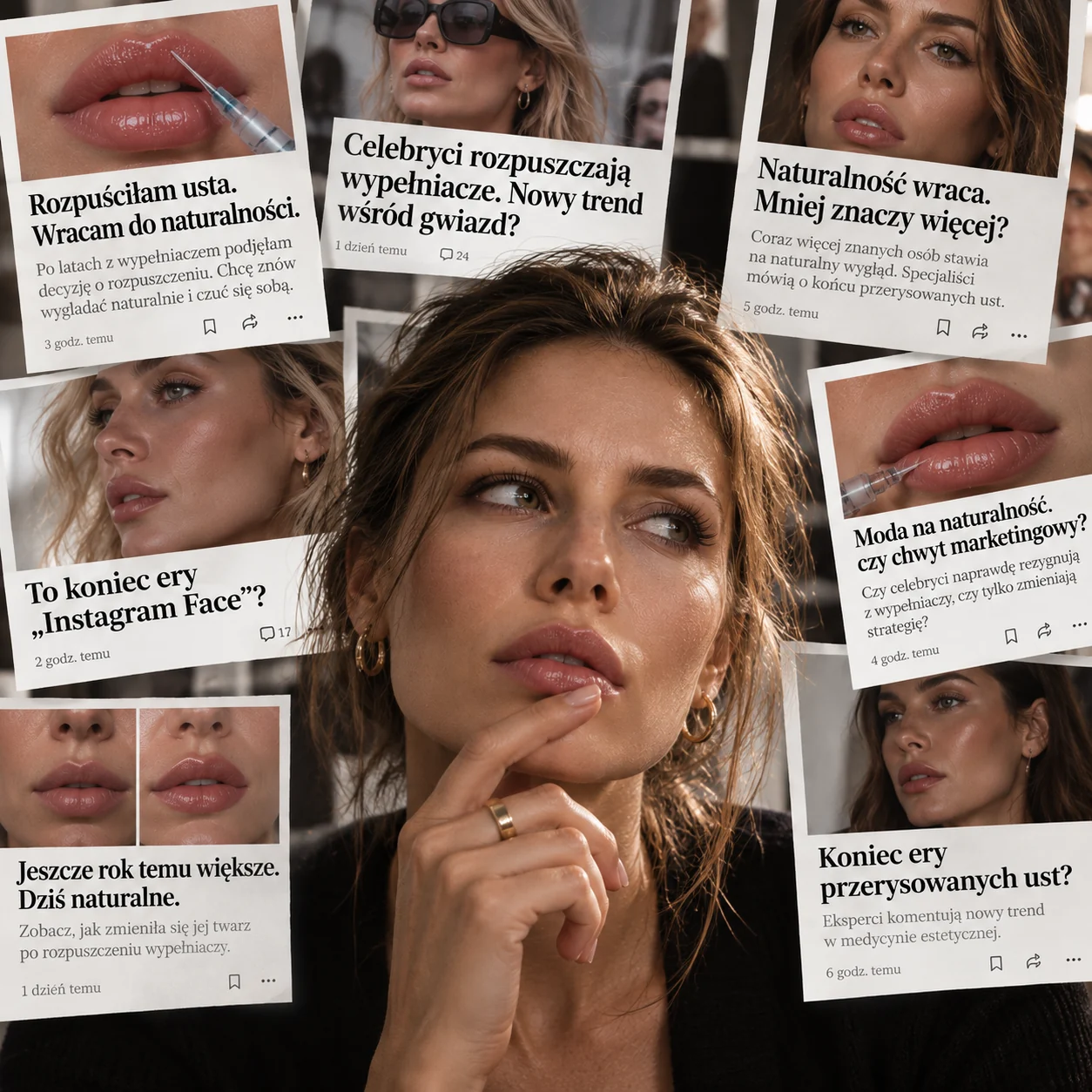
“Natural beauty is back.” “Celebrities are dissolving their fillers.” The internet is announcing the end of exaggerated lips, visibly ‘done’ faces and the old era of aesthetic medicine. Yet one detail gets lost in all this media noise: aesthetic treatments are not disappearing. Quite the opposite. They are entering a much more mature phase, while their popularity is reaching a peak.
This is not the end.
It is only the beginning.
The beginning of an approach in which aesthetics stops meaning changing a person to fit a ‘standard’ and starts meaning conscious management of ageing processes, skin quality, facial proportions and natural facial architecture.
We talk to an expert about why natural-looking results do not mean giving up aesthetic treatments, what is really happening with the trend of dissolving lip fillers and why the future of aesthetics may be more advanced than ever before.
Are we really witnessing the end of cosmetology and aesthetic medicine?
No. We are witnessing the end of a certain way of thinking about aesthetics. And that is a good thing.
When aesthetic treatments began reaching a wider audience, they were fascinating. We gained tools that made it possible to correct proportions, reduce visible signs of ageing, improve facial contours and restore or increase tissue volume.
For years, one philosophy dominated: if we can improve something, let us improve it more.
Bigger lips. Stronger cheekbones. A sharper jawline. More volume. Another syringe. Another treatment. For many people, the rule was simple: the more, the better.
The truth is that more has never automatically meant better.
And that is the biggest change.
For years, specialists had to deal with clients who wanted everything done. Explaining that another treatment would not improve the result — and could actually disturb it — was often ineffective. The client would move on, looking for someone who, instead of saying ‘no’, would simply fulfil the request. Unfortunately, there has never been a shortage of people willing to put profit before good judgement.
Today, more people understand that aesthetic treatments should not rebuild the face according to a single beauty standard. Their role should be to bring out what is most attractive in a particular face, preserve its character and improve proportions without taking away individuality.
Perhaps this is the most important shift: from ‘let us do more’ to ‘what is actually worth doing so that I still look like myself?’
Good aesthetics should not be a collection of random procedures or the sale of services ‘by the millilitre’. It should resemble well-designed architecture.
Does the ‘return to natural beauty’ mean giving up aesthetic treatments?
This is where one of the biggest paradoxes of contemporary aesthetics appears.
The slogan ‘a return to natural beauty’ is true, but the way the internet interprets it often is not. It tends to hide what is inconvenient and highlight what is catchy and shareable.
In reality, looking natural does not mean having had no treatments. Paradoxically, it may mean the opposite.
Is the trend towards natural beauty killing aesthetic treatments?
Quite the opposite.
It raises the bar.
Exaggeration is easy.
Restraint requires more knowledge and experience.
Is that why we hear so much about longevity today?
Yes. Although the word longevity itself is also becoming overused in marketing.
In its sensible meaning, this direction is about moving away from desperately trying to ‘reverse age’ and towards long-term care for the condition of the body and tissues.
In aesthetics, this includes interest in:
- skin quality and function
- stimulation of regenerative processes
- protection against photoageing
- preserving correct facial proportions
- analysing changes that occur with age
- proper treatment planning
- combined therapies
- prevention instead of later aggressive correction
It is a much more mature approach.
We no longer ask only: “How do we remove this wrinkle?”
We ask: “Why is this face beginning to look tired, and which processes are responsible for it?”
Sometimes the problem really is a wrinkle.
Sometimes it is the loss of supportive fat tissue.
At other times it may be a change in skin tension, remodelling of deeper structures, photodamage, facial expression or proportions.
Are hyaluronic acid and other ‘old’ treatments becoming obsolete?
No.
And that is one of the biggest myths.
You do not throw away a good tool simply because someone once used it badly.
The philosophy changes.
In the past, we often started with the question: “What can we do?”
Today, the better question is: “What should we actually do — and what should we not do?”
Knowing when not to perform a treatment can be just as important as knowing how to perform it.
What about lip augmentation? Many people, including celebrities, are dissolving their fillers
This is where we can see most clearly how a media shortcut can distort reality and create a false picture in the public mind.
Yes, many people decide to dissolve previously injected hyaluronic acid — but often for a completely different reason.
The sentence ‘People are dissolving their lips because lip augmentation is going out of fashion’ is catchy, highly shareable and often commercially useful.
And this is where online narratives can become almost absurd.
A well-known person posts a photo on social media with the caption: ‘I dissolved my lips. I am going back to natural.’
The internet immediately announces the death of fillers.
A few months later, the same face still looks remarkably harmonious, the lip proportions remain attractive, the contour is orderly, and the public interprets this as a triumph of ‘naturalness’. People then follow the new trend without thinking, sometimes with negative consequences.
The reality is often somewhere else entirely.
A natural-looking result and a lack of intervention are not the same thing.
That distinction is worth remembering, because misleading media narratives can push many young people into unnecessary complexes and traps.
Are celebrities lying when they say they are returning to natural beauty?
I would not use the word ‘lying’, but the term is certainly often overused and can be used for reach and image-building. Today, the word ‘natural’ carries enormous marketing value.
A few years ago, it was attractive to say publicly: ‘I had my lips done.’
Today, more image value can come from saying: ‘I dissolved everything. I choose myself.’
The narrative has changed.
Most importantly, the desired result has changed. Celebrities, influenced by the highly shareable trend towards naturalness, may dissolve lip filler in order to model the lips again — but in a different style. A style in which they can publicly describe themselves as ‘natural’ while followers write: ‘So much better natural. Why did you ever do that?’
And this needs to be stated clearly: lip repair, lip correction, changing the lip-modelling technique and similar procedures are not the same as returning to an untreated state.
Are social media responsible for all this confusion?
Very much so.
Social media have a particular ability to turn complex phenomena into two opposing slogans.
First: ‘Everyone should improve something.’
Now: ‘Everyone should be natural.’
Both messages are equally simplistic.
Not everyone needs a treatment.
And not everyone should give one up simply because a TikTok trend has changed.
Aesthetics should not work like an autumn-winter fashion collection.
A face is not a seasonal accessory.
Can we say that the era of ‘Instagram Face’ is ending?
An industry that was meant to emphasise individuality sometimes began producing clones. The same lips, the same cheeks, the same face.
Today, celebrities suddenly promote ‘naturalness’ because fashion works in a predictable way: once something becomes widespread, a new way of standing out is needed.
But we should not fall for the fairytale of a great return to nature. Very few people are giving up aesthetic treatments altogether, especially in the celebrity world. What is changing is the way treatments are performed: less exaggeration, more discretion, better proportions and a result that looks ‘natural’.
And then social media turns that into highly shareable content about a ‘return to natural beauty’.
That is exactly how it works.